
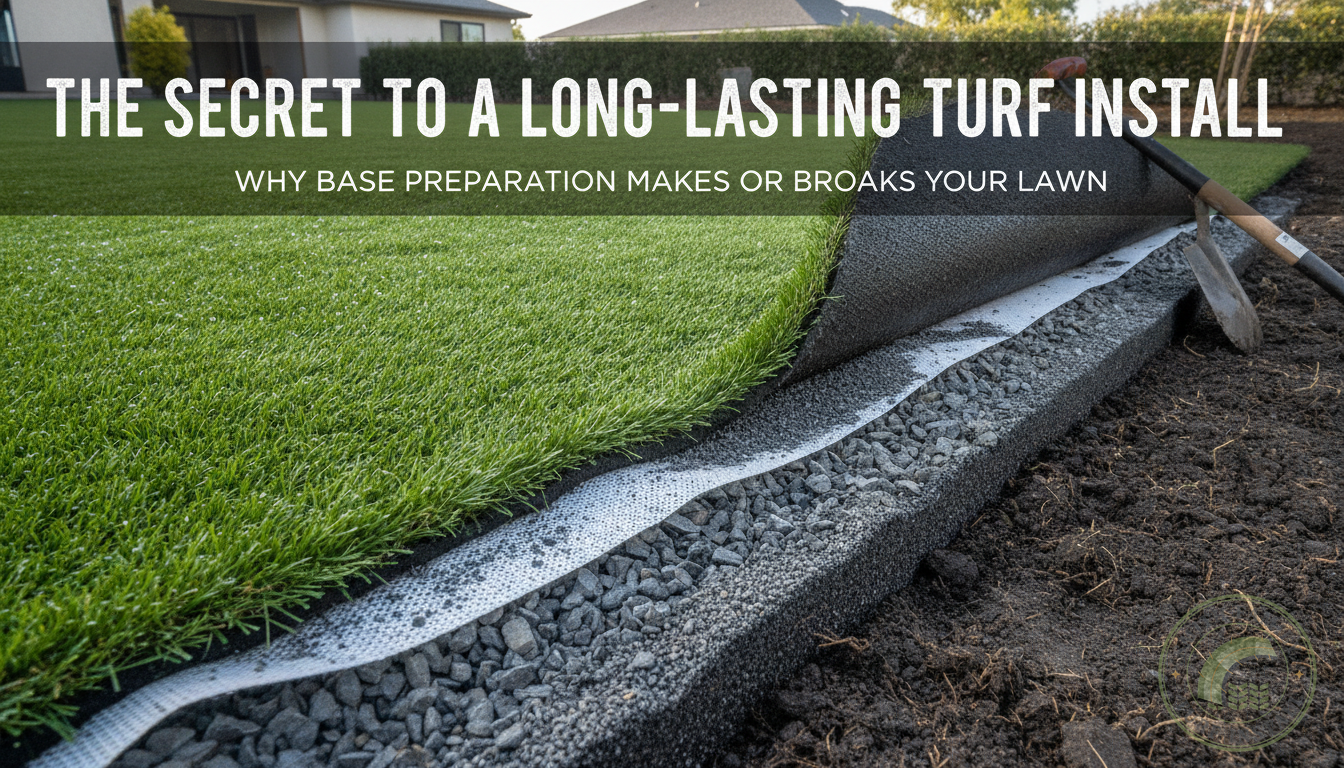
Walk into any home improvement store and you'll find artificial turf rolls on display. Browse online and you'll find dozens of products at a wide range of price points. It's tempting to think the grass itself is the whole story — pick the right product, roll it out, and you're done. But experienced turf installers will tell you something different: the most important part of any synthetic lawn project happens underground, before the turf ever arrives on site.
At Smith Family Granada Hills Turf Install, we've seen what happens when base preparation is rushed or skipped. Turf that bubbles after the first winter rain. Soft spots that develop into tripping hazards. Standing water that breeds odors and creates drainage problems. These aren't turf problems — they're base problems. And they're entirely preventable when the sub-surface work is done correctly from the start.
What Is Turf Base Preparation and Why Does It Matter?
Before your new synthetic lawn is installed, the ground beneath it needs to be properly excavated, graded, and compacted to create a stable, well-draining foundation. This process — which we call turf base preparation — is what separates installations that last two decades from ones that start failing in year three or four.
In Granada Hills and throughout the broader San Fernando Valley, native soils tend to have significant clay content. Clay soils expand when wet and contract when dry, which creates movement in anything sitting on top of them. They also drain poorly, which means water can pool beneath the turf surface if drainage isn't deliberately engineered into the base design. A quality base preparation process addresses both of these issues before the turf ever goes down.
Step One: Excavation and Vegetation Removal
The first step in our base prep process is removing existing vegetation — whether that's dying natural grass, old landscaping, or bare weeds — along with all root material. Organic matter left in the sub-base will decompose over time, creating voids and uneven spots that show up as bumps and dips in your finished lawn surface.
We then excavate native soil to a depth of three to four inches below the finished grade. This depth accommodates a weed barrier layer, a full compacted aggregate base, and the turf system itself. In areas with particularly poor-draining clay soils — something we encounter frequently in parts of Granada Hills — we may recommend slightly deeper excavation to accommodate additional drainage material.
Step Two: Weed Barrier Installation
Once the native soil is cleared and the excavation depth is correct, we install a commercial-grade weed barrier fabric across the entire area. This layer prevents any residual weed seeds or root fragments from pushing up through your new turf over time. Without it, you can end up with weeds growing through the backing of your synthetic grass — an annoying problem that's difficult to address after the fact.
Step Three: Aggregate Base Spreading and Compaction
This is the most critical phase of the entire process. We spread a layer of Class II road base or crushed decomposed granite across the prepared area, carefully graded to promote positive drainage — meaning water flows away from your home's foundation and toward designated drainage points rather than pooling beneath the turf surface.
We then make multiple passes with a plate compactor to compress the aggregate into a dense, firm, stable surface. This compaction step is where corners are most commonly cut by less thorough installation crews. A single pass with a compactor isn't enough. Proper compaction requires systematic, overlapping passes that achieve consistent density across the entire base area. When we're done, the surface should feel like firm, natural ground underfoot — not soft or spongy in any area.
This same meticulous approach to base prep is why our backyard putting green installations play so consistently. A putting green requires precise grade control and deliberate contouring to create realistic breaks and undulations — none of that is possible without a perfectly prepared and compacted sub-surface.
What Happens When Base Prep Is Done Wrong
We regularly receive calls from Granada Hills homeowners who had turf installed by another company and are now experiencing problems. The most common issues we see:
- Bubbling or lifting turf: Usually caused by organic material decomposing beneath the surface or insufficient compaction that allows the base to shift over time.
- Standing water after rain: The result of flat or negative grading — water that has nowhere to drain sits beneath the turf and eventually finds its way to the surface.
- Soft or spongy spots: Indicate areas where compaction wasn't thorough, creating voids in the aggregate base that compress further under foot traffic.
- Visible seams or edge separation: Can result from an uneven base that causes the turf to pull away from borders or shift at seam locations.
In most of these cases, correcting the problem requires removing the existing turf, repairing the base, and reinstalling — which is why getting the base right from the beginning is the smarter and more economical choice. Our artificial turf removal and replacement service handles exactly these situations, but we'd always rather help a homeowner avoid that expense entirely by doing the initial installation correctly.
Our Base Preparation Standards for Granada Hills Projects
Every artificial turf installation we complete in Granada Hills includes full base preparation as a non-negotiable part of the project scope. We don't offer a "base-not-included" price tier, because an installation without proper base prep isn't an installation we're willing to stand behind.
When you request a quote from Smith Family Granada Hills Turf Install, we visit your property and assess the existing soil conditions, current grade, and any drainage challenges specific to your yard. We then build the base preparation scope into our proposal transparently — you'll know exactly what excavation depth we're planning, what aggregate material we're using, and how we're addressing any drainage concerns before we start.
Serving Granada Hills and Surrounding Communities
Our base preparation and turf installation work spans Granada Hills and the surrounding San Fernando Valley, including Northridge, Chatsworth, Porter Ranch, Sylmar, Reseda, and North Hills. Soil and drainage conditions vary across these neighborhoods, and our familiarity with local site conditions helps us design base systems that perform correctly in your specific area.
Ready to learn more about what goes into a quality turf installation? Visit our